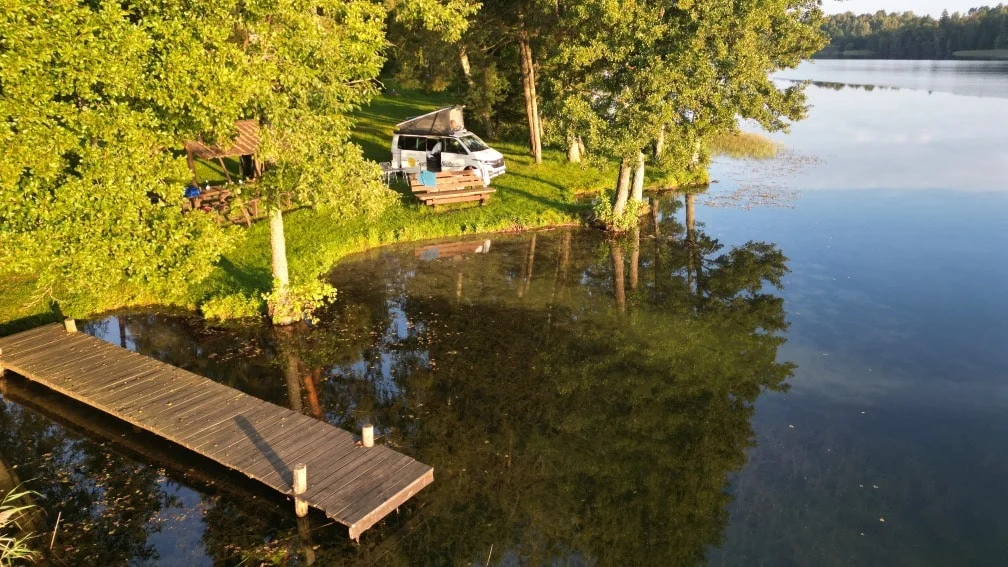

By the VanBaltic Travel Team · Last updated: July 2026 · 10 min read
The best time to visit the Baltics by campervan depends on what you want from the trip, but the shoulder months either side of summer – May, June, September, and October – land in the sweet spot of mild weather, real daylight, and thinner crowds. September alone gives Riga nearly 14 hours of light at the start of the month and 11 hours 36 minutes by the 30th, days warm enough for hiking and cooking outside, and lower rates than peak July and August.
This guide walks through every season honestly – what the weather, daylight, crowds, campsites, and costs actually look like – so you can match the calendar to your kind of trip, whether you are flying into Riga for a two-week loop up to Estonia or a long weekend on the Latvian coast.
Best Time to Visit the Baltics: A Season Snapshot
VanBaltic groups the year into four pricing tiers, and they double as a decent map of what each stretch of the calendar feels like on the road. Here is the shape of the year at a glance.
Rates shown are the entry Beach Space trim, per night, before length discounts. Ocean Comfort and Ocean Premium sit higher in every tier. You can see the full grid on the VanBaltic prices page. Temperature and daylight figures are for Riga; Tallinn and Vilnius vary by a degree or so.
The Best Time to Visit the Baltics, Season by Season
No single season wins for everyone. Each one suits a different traveler, so it helps to be honest about who each one is really for.
Summer (July and August) is for people who want the warmest swimming weather, the longest evenings, and the full run of coastal festivals, and who do not mind sharing the popular spots. Late spring (May and June) is for those who want everything green and waking up, long days already arriving, without the peak-season prices or busy campsites.
Autumn (September and October) is for travelers who value calm over buzz: quiet roads, forests turning color, comfortable daytime temperatures, and the lowest rates outside the off-season. Winter (November to March) is a niche of its own, a long-term-only stretch for a specific kind of cold-weather trip rather than a two-week fly-in loop.
If your priority is reaching Estonia at a relaxed pace with room to be spontaneous, the shoulder seasons give you the most road to yourself. Our guide to how many days you need to explore the Baltic states pairs well with this, since season and trip length together decide how much ground you can cover comfortably.
Autumn in the Baltics by Campervan
Autumn is the season that rewards a campervan most. The crowds of July and August have gone home, the roads north to Estonia are quiet, and the forests that cover so much of Latvia, Lithuania, and Estonia turn gold and rust through September and October. You get the region close to how the locals experience it.
It is also mushroom and berry season, a genuine cultural event here. Baltic families head into the pine forests with baskets on weekend mornings, and a campervan puts you right at the trailheads where the good spots are. Cooler air means the mosquitoes and horseflies that pester summer campers are largely gone, so evenings outside the van are more pleasant, not less.
September and October are not the same trip, though.
September feels like a gentler extension of summer: warm enough for a swim on a good day, long light in the early weeks, and campsites still open and staffed. It is Mid season, not off-peak, which is worth being clear about – you get quieter roads without giving up much of summer’s comfort.
October leans into the calm. Days are shorter and wetter, temperatures dip, and you will want the van’s heating in the mornings, but the color peaks and the sense of having the trails to yourself is real. It is Low season, so daily rates drop to their lowest before the winter closure.
Where the campervan earns its keep in autumn is the heating and the sleeping setup. The pop-up roof plus lower bed sleeps up to four, and the heater keeps the cabin warm overnight, so a 5C October night outside is a warm bunk inside. That is the difference between camping being a chore and being comfortable. For where to point the van, our roundup of the top nature trails in the Baltic states is built for exactly this kind of foliage-season hiking.
Weather and Daylight, Month by Month
The single biggest myth about an autumn Baltic trip is that the daylight disappears. It does not. Riga still has 11 hours 36 minutes of daylight on September 30, and about 9 hours at the end of October, according to timeanddate.com. That is plenty for a full day of driving between towns and sightseeing, as long as you start reasonably early.
Through September, Riga runs from a sunrise around 6:25am and sunset near 8:20pm at the start of the month to roughly 7:24am and 7:01pm by the 30th. October takes daylight from 11 hours 32 minutes down to 9 hours 11 minutes, and the clocks go back on the last Sunday of the month, which shifts the evening earlier.
On temperature, holiday-weather.com puts Riga’s September average high at 15C with lows around 9C, and about 90mm of rain over roughly 13 rainy days. October cools to an 11C high and 5C low, with around 16 rainy days. Tallinn, up on the Estonian coast, sits a touch milder in September, near a 17C high and 7C low, then colder by October at about 10C and 2C.
The practical takeaway: pack layers and a proper rain shell for any autumn trip, plan your longest driving legs for the middle of the day when the light is best, and let the van’s heating do the work in the mornings and evenings. None of this shortens the trip; it just shapes the rhythm of each day.
Summer, Spring, and Winter for a Campervan Trip
Summer is High season for a reason. July and August bring the warmest, driest weather, the longest evenings, and the full calendar of coastal life. It is the easiest time to swim, to camp without heating, and to travel with kids. The trade-offs are the busiest campsites, the most traffic in the capitals, and the highest rates, with the Beach Space at 130 EUR per night. If summer is your window, our Baltic road trip itinerary maps a Riga loop that works well when the days are long.
Spring arrives properly in May and June, both Mid season. The landscape greens up fast, daylight is already generous, and you get much of summer’s ease at a lower rate and with fewer people. April is Low season and can still be raw, but for late spring the balance of price, light, and mildness is one of the year’s best.
Winter is a different animal. November through March is off-season and available as long-term rental only, with a 30-day minimum, so it is not a slot for a standard week-long fly-in trip. It is also when winter tyres become mandatory, and those dates are the practical reason autumn has a hard back edge. According to the European Consumer Centre (evz.de), winter tyres are required in Lithuania from November 10, and in Latvia and Estonia from December 1 to March 1. Plan a normal autumn trip to wrap up by late October or very early November.
Campsites and Camping by Season
Camping infrastructure follows the season. Through summer and into September, staffed campsites, guesthouse pitches, and coastal sites are open and busy, with full facilities. This is the simplest time to string together a route with services every night.
By October, some seasonal sites wind down, but plenty stay open, and the quieter network is easier to book on short notice. This is where being spontaneous pays off: you are rarely competing for a pitch, and you can change plans by the weather rather than by a reservation calendar.
Autumn camping is genuinely comfortable when the van is doing the heavy lifting. You cook and sit out during the mild afternoons, then retreat to a heated cabin as the temperature drops after dark. Fewer insects, quieter sites, and campfire-season evenings make it a calmer experience than a packed August. If Estonia is your target, our guide to Estonia’s hidden gems by camper flags spots that are especially good once the crowds thin out.
What a Baltic Campervan Trip Costs by Season
Season is the biggest lever on what you pay. VanBaltic prices in four tiers, and the gap between High and Low is real money over a two-week trip.
Two points worth being precise about. First, September is Mid season, not off-peak, so it is priced between summer and the true low months rather than at rock bottom. Second, the genuinely lowest daily rates fall in April and October, the Low tier, while November to March is off-season and long-term only. If your goal is the lowest nightly rate on a standard trip, October is your month.
Length discounts then stack on top of the seasonal rate: 5 percent from 8 nights, 10 percent from 15 nights, and 15 percent from 22 nights. A longer October trip in a Beach Space therefore compounds a low base rate with a length discount, which is about as economical as a Baltic campervan trip gets. The current figures and any add-ons live on the prices page.
Planning an Autumn Fly-In Trip
An autumn fly-in loop works cleanly. You land at Riga Airport (RIX), and pickup and return are about 10 minutes away, seven days a week, so you can collect the van the day you arrive and drop it the day you leave. The handover details are on the rental stations page, and if this is your first campervan trip, how it works covers the whole process end to end.
From Riga, the natural autumn route runs north into Estonia, since Estonia is what most fly-in visitors come to see. Riga to Tallinn is an easy drive with worthwhile stops along the way, and the foliage through the Estonian forests is a highlight in late September and October. For a nature-led version of the route, our Riga to nature’s best guide lays out a 7 to 14 day plan.
A few logistics to lock in before you book. The minimum driver age is 23 for all drivers. Traveling with a dog is fine for a 99 EUR pet fee, which suits an off-season trip where you are outdoors most of the day. And mileage is unlimited only within Latvia, Lithuania, and Estonia, which is exactly the triangle an autumn loop covers, so it rarely limits a Baltic-focused trip. Just keep the winter-tyre dates in mind if your plans push into November.
When your dates are set, you can check availability and reserve on the booking page, or start from the campervan hire overview if you are still weighing trims. Autumn availability tends to be easier than peak summer, but the good weeks still go.
Frequently Asked Questions
When is the best time to visit the Baltics by campervan?
The best time to visit the Baltics by campervan is whichever season fits your priorities. July and August bring the warmest weather and longest days, but also the biggest crowds. May, June, and September are mid season: mild, green, and quieter. If you want calm roads, foliage, and lower rates, autumn shines. Each season works, so pick the trade-offs you prefer.
What is the weather like in the Baltics in September versus October?
September in Riga averages a 15C high and 9C low, with around 90mm of rain over about 13 rainy days. October cools to an 11C high and 5C low across roughly 16 rainy days. Tallinn runs a touch milder in September and colder by October. Pack layers and a rain shell, and the van’s heating handles the cooler nights.
When are campervan rental rates lowest in the Baltics?
Low season, which is April and October, carries VanBaltic’s lowest daily rates, starting at 90 EUR per night for the Beach Space trim versus 130 EUR in July and August. September is mid season, priced between the two. Length discounts stack on top: 5 percent from 8 nights, 10 percent from 15, and 15 percent from 22. November through March is long-term rental only.
Is autumn too cold for campervan camping in the Baltics?
No. September days sit around 15C and October around 11C, comfortable for hiking, cooking outside, and sightseeing. Nights get cooler, but the campervan’s heating keeps the sleeping area warm, so you are not relying on the outside temperature. Fewer insects and quieter campsites make autumn one of the more relaxed times to camp in the Baltics.
Do the Baltic days get too short in autumn to drive and sightsee?
No. Baltic daylight does not collapse to a handful of hours in autumn. Riga still has 11 hours 36 minutes of daylight on September 30, and about 9 hours at the end of October. That is plenty for a day’s driving between towns plus sightseeing, especially if you start early and plan the longest legs for the middle of the day.
Can I fly in and reach Estonia by campervan in autumn?
Yes. You land at Riga Airport, pick up the van about 10 minutes away, and drive north through Latvia to Estonia and Tallinn. Autumn roads are quiet and the foliage along the way is a bonus. Aim to stay inside Latvia, Lithuania, and Estonia, where mileage is unlimited, and keep an eye on winter-tyre dates from late autumn.
How late into autumn can I travel before winter tyres are required?
Winter tyres become mandatory in Lithuania from November 10, and in Latvia and Estonia from December 1. That makes late October and early November the practical end of a standard autumn trip. Book within the Low and Mid season window, through October, for the easiest conditions, and confirm the tyre setup with VanBaltic if you plan to travel into November.
Sources and Data
- VanBaltic, season pricing tiers and length discounts, 2026 – vanbaltic.com/prices
- timeanddate.com, Riga sunrise, sunset, and daylight figures for September and October, 2026 – timeanddate.com/sun/latvia/riga
- holiday-weather.com, Riga and Tallinn September and October temperature and rainfall averages, 2026 – holiday-weather.com
- European Consumer Centre (evz.de), winter-tyre requirements in Lithuania, Latvia, and Estonia, 2026 – evz.de
- Visit Estonia, autumn and nature travel in Estonia – visitestonia.com