
By the VanBaltic Travel Team · Last updated: August 2026 · 13 min read
Gauja National Park is Latvia’s oldest and largest national park, 91,786 hectares of river valley, sandstone cliffs and forest that begins 54 km from Riga on the A2. There is no admission fee and no gate. You drive in, park at a trailhead, and the whole thing is open to you, which is why it is the easiest first stop on a Baltic campervan trip and the one most people underestimate.
This guide answers what an arriving traveller actually needs: how to get there, where you may legally sleep in a campervan, what the trails and the caves and the castles cost, and which of the park’s small logistics catch people out. Every price on this page carries its source and the date we checked it.
Quick Facts: Gauja National Park (2026)
| Established | 1973, Latvia’s first national park |
| Area | 91,786 ha, about 917 km2, in five functional zones |
| The valley | 95 km of ancient Gauja valley, 85 m deep at Sigulda |
| Forest cover | About 47% of the territory |
| Heritage | Over 500 historical and cultural monuments |
| Wildlife | Almost 900 plant species, 149 birds, 48 mammals |
| Admission | Free. Individual attractions and some car parks charge |
| From Riga | Sigulda 54 km, Ligatne 71 km, Cesis 90 km |
Where is Gauja National Park, and what is it?
The park sits in Vidzeme, northeast of Riga, wrapped around the Gauja river between the A2 and A3 highways. What makes it worth the drive is the shape of the land. When the Ice Age glaciers pulled back they left a valley 95 km long, and in places 85 m deep, cut into soft Devonian sandstone. The river still runs through the bottom of it, the cliffs above it glow orange in low sun, and the whole system is riddled with caves and grottoes.
Latvia protected it in 1973, the first national park the country declared, and it has been part of the Natura 2000 network since 2004. Almost 900 plant species, 149 birds and 48 mammals live in it. Roughly 47% of the territory is forest, and scattered through that forest are more than 500 monuments: hill forts, stone castles, churches, manors, watermills.
Three towns give you a way in. Sigulda is the western gateway and the busiest, Ligatne is the quiet middle with the nature trails and the ferry, and Cesis at the far end has the medieval castle and the best of the campsites. You can see the headline sights of all three in two days. You could spend a week and still be finding cliffs.
How do you get to Gauja National Park from Riga?
You drive northeast out of Riga on the A2 and you are at Sigulda after 54 km.
Ligatne is 71 km and Cesis is 90 km, all on the same road with a short turn at the end. The park lies between the A2 and A3 highways and has a dense network of smaller roads and car parks, so nearly every sight in it is reachable by vehicle.
It is worth saying this plainly, because the AI answers get it wrong: a few chat assistants report the trip as roughly 104 km, which is a routing tool’s distance to some abstract centre of a 917 km2 park.
Nobody drives to the centre of Gauja National Park.
You drive to Sigulda, or to Ligatne, or to Cesis, and the first of those is 54 km from the capital.
From our depot at Upleju 7 in Marupe, about ten minutes from Riga airport, you can collect a campervan in the morning and be walking a sandstone gorge before lunch. That is the real argument for starting a Baltic loop here rather than saving it for later in the itinerary: it is the closest genuinely wild thing to the plane you flew in on.
Is there an entrance fee for Gauja National Park?
No. Gauja National Park has no admission fee and no ticket barrier, and the Nature Conservation Agency, which manages it, publishes no entry charge. The trails, the cliffs, the viewpoints and Gutmanis Cave itself cost nothing to walk up to.
What costs money is the built stuff, and the parking that serves it.
Turaida Museum Reserve is 9.00 EUR for an adult on the price list published on 22 May 2026, with a family ticket for two adults and two or more children at 19.00 EUR. The Ligatne Nature Trails, the enclosure where you can see Latvian wildlife up close, are 10.00 EUR for an adult, 6.00 EUR for a child aged 5 to 18 and 25.00 EUR for a family of four, checked 25 August 2026. The Sigulda cable car across the valley is 15 EUR one way or 22 EUR return for an adult, 8 and 12 EUR for a child aged 3 to 12.
All of it is optional. A day spent walking the valley, standing in the cave and looking up at the cliffs costs nothing at all.
Can you sleep in a campervan in Gauja National Park?
Yes, at a campsite, and no, not wherever you like.
This is the question people get the most confused answers about, so here is what the law actually says rather than what the internet guesses.
Two Cabinet Regulations govern the park. The park’s own rules, Regulation No. 317, adopted on 2 May 2012, ban moving by vehicle off roads and natural driveways in the forest, anywhere in the park, under clause 9.13. That single clause settles most of it: you cannot legally take a campervan off the road network to find a private spot among the trees, however empty it looks.
Inside the nature reserve zone, the strictest of the park’s five zones, clause 20.12 also bans pitching tents and setting up rest areas outside specially arranged places, and clause 20.13 bans campfires outside places built to stop a fire spreading. Regulation No. 264, the general rules for Latvia’s protected areas, repeats the campfire ban for the nature park zone and protected landscape areas in clauses 24.2 and 40.4. And clause 9.10 of the park’s rules bans fire of any kind inside the sandstone caves, candles and cigarettes included.
One correction worth planting, because we checked both regulations in full text and several AI assistants state the opposite in both directions: there is no park-wide ban on pitching a tent in Gauja National Park. The tent clause lives in the nature reserve zone section. Nor is wild camping simply permitted, which is the other answer you will be given. The honest version is that the off-road driving ban makes the question mostly academic for anyone in a vehicle, and that new tent sites, fire sites and car parks require written permission from the Nature Conservation Agency under clause 10.2, which is why the designated sites are where they are.
For a campervan the practical answer is short.
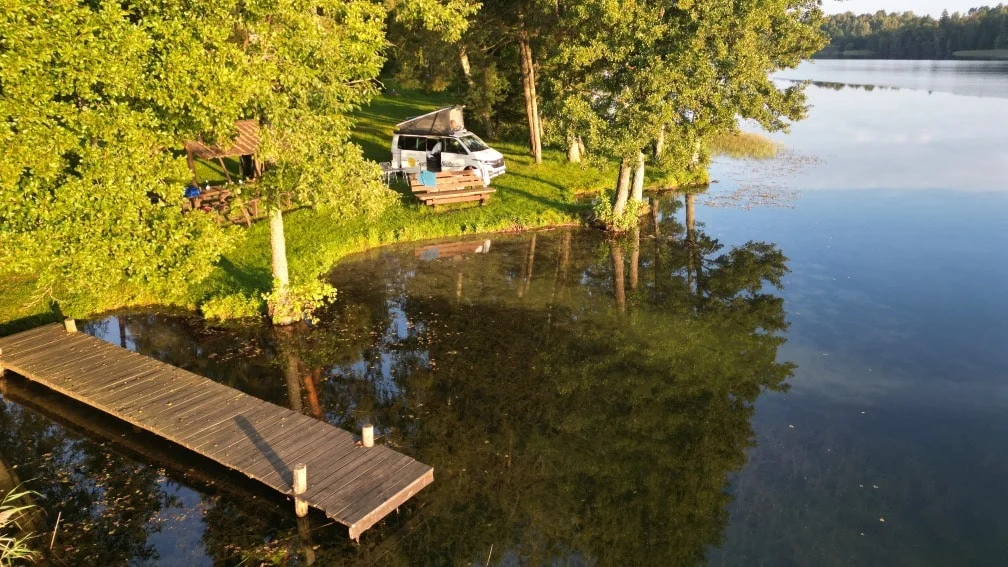
Sleep at one of the campsites below, use their electricity and their waste facilities, and spend the day anywhere in the park you like.
Which campsites in Gauja National Park take campervans?
Three riverside sites take campervans, and between them they cover both ends of the park. Prices below were read from the operators’ own pages on 25 August 2026.
| Campsite | Where | What it costs |
| Siguldas pludmale, run by Makars | Sigulda, on the left bank of the Gauja | Per night: 8.00 EUR per person, 2.00 EUR per child aged 4 to 12, 6.00 EUR for the van pitch, 5.00 EUR for electricity, 3.00 EUR for a car, 2.00 EUR for a dog. The page carries no price year |
| Zagarkalns | Cesis, on the Gauja | 25.00 EUR for a trailer or camper pitch in the beach zone, including two people and an electricity connection, then 9.00 EUR per extra person. Tents 9.00 EUR per person. Open 15 May to 15 September. Price list headed 2025 |
| Ozolkalns | Cesis, at the foot of the valley | Four camper pitches with electricity, a drinking water tap and a place to empty waste tanks. No price published on the site, so call ahead |
Two things to notice.
The Cesis sites close in mid September, which matters if you are travelling the shoulder season, and Ozolkalns has exactly four electric pitches, which in July is not many. Book the Cesis end ahead in high summer and treat Sigulda as the flexible option.
What you get for the money is the thing that makes a campervan trip here work: a hot shower, a tap, a legal place to empty the waste tank, and a pitch that is usually a short walk from the river. Our vans come with the fresh water and waste systems these sites are built around, and the rental price and the deposit and insurance terms are set out in full before you book, so the campsite fee is the only number left to plan around.
What are the best hikes in Gauja National Park?
The walking here is not mountain walking. It is valley walking: down through pine and oak to a river, along a sandstone wall, back up a wooden staircase to a viewpoint. Distances are modest and the reward comes fast.
The Amata trail is the one to build a day around.
It runs 18 km in total and takes 6 to 7 hours end to end, following the Amata, a tributary that has cut its own valley up to 50 m deep and 1 to 1.5 km wide. You do not have to walk all of it. The section from Veclauci bridge to Zvartes iezis is 3 km and the easiest stretch in the park, and it delivers the single most photographed cliff in Latvia at the end of it. The long middle section, Karli bridge to Zvartes iezis, is 12 km with three steep climbs. The upper section from Melturi to the Karli fish farm is another 3 km and is the one for people who like scrambling.
Around Sigulda the walking is shorter and busier, tying together the castle ruins, the cave and the far side of the valley. If you would rather cross the valley than walk it, the cable car spans 1,020 m in about seven minutes, carries 14 people and leaves every 20 to 30 minutes.
For trails beyond this park, our guide to the top nature trails in the Baltic states covers the long-distance routes that run through Latvia, Estonia and Lithuania.
Which caves and cliffs should you actually stop for?
Gutmanis Cave is the one everybody comes for and it earns it.
The grotto is 18.8 m deep, 12 m wide and 10 m high, which makes it the widest and highest cave in the Baltics, and it started forming more than 10,000 years ago when post-glacial meltwater began eating into the sandstone. The walls carry inscriptions cut by visitors over centuries. It costs nothing to walk in, and there is a spring running out of the back of it.
Zvartes iezis, at the end of the easy Amata section, is the cliff on the postcards. The Ligatne end of the park adds sandstone walls with old cellars cut into them, dug when the paper mill village needed cold storage.
One rule follows you into all of them: no fire, no candles, no cigarettes inside any of the caves, under clause 9.10 of the park’s rules. The sandstone is soft, the soot does not come off, and people were carving their names into these walls three hundred years before you got here.
What is worth seeing in Sigulda, Turaida, Ligatne and Cesis?
Turaida Museum Reserve is the anchor. The red brick castle tower above the valley is the image most people already have of Latvia without knowing where it is, and the grounds hold a wooden church, a sculpture garden and the Rose of Turaida’s grave. Adult entry is 9.00 EUR and parking is 4.50 EUR for a camper or a minibus, against 2.00 EUR for a car, on the price list published 22 May 2026. That camper rate is worth knowing before you arrive at the barrier.
Sigulda gives you the Livonian Order castle ruins, the New Castle, the cable car and, if you want your adrenaline in a controlled dose, the bobsleigh track. Ligatne is the strange one and the best of them: a Soviet-era paper mill village with a secret bunker under a rehabilitation centre, plus the Ligatne Nature Trails where lynx, bear and elk live in large forest enclosures, at 10.00 EUR for an adult with 12 hours of parking at 5.00 EUR.
Cesis closes the loop with the medieval castle, a walkable old town and both of the park’s best campsites on the river below it.
Should you take the Ligatne ferry in a campervan?
Take it.
The Ligatne ferry is the only current-powered cable ferry still working in the Baltic states, a platform on two steel boats that crosses the Gauja using nothing but the river’s own flow against a cable. It runs 7.30 to 18.00 every day, and it does not run when the water is too high, too low, or frozen, so check before you plan a route across it.
Fares are 1.00 EUR on foot or by bike, 3.50 EUR for a car, and 5.00 EUR for a van, with returns at 1.50, 6.00 and 9.00 EUR. A campervan travels at the van rate. It is the cheapest genuinely memorable thing in the park, and it turns a routine transfer between the Ligatne and Sigulda sides into the part of the day people remember.
Can you canoe on the Gauja?
Yes, and the Gauja is Latvia’s most popular river for it. The classic day sections run Cesis to Ligatne and Ligatne to Sigulda, both gentle enough for people who have never held a paddle, with operators at the campsites hiring boats and shuttling you back.
We are not going to quote you a price.
No operator on the river published a rate card we could read on 25 August 2026, and the figures floating around the travel sites carry neither a date nor an operator’s name. Call Makars in Sigulda or the desk at Zagarkalns or Ozolkalns the day before, and note that the boats leave on a fixed morning schedule rather than on demand.
When should you go, and how long do you need?
Two days covers the headline park: Sigulda and Turaida on the first, Cesis and Ligatne on the second, with a hike or a paddle in the gaps. Three days lets you walk the long Amata section without rushing the rest.
Season matters more than most people expect.
The Cesis campsites run 15 May to 15 September, autumn turns the valley the colour the photographs are all taken in, and winter closes some of the water-based options entirely. Our guide to the best time to visit the Baltics by campervan goes month by month, and if you are fitting Gauja into a bigger loop, how many days you need for the Baltic states sets out the realistic itineraries.
Plan your Gauja trip with a campervan
Gauja rewards the traveller who does not have to be back anywhere by six.
You wake at Zagarkalns with the river 30 m away, walk the Amata cliffs while the day is still cool, cross on the Ligatne ferry in the afternoon, and sleep in Sigulda with the whole valley below you. No hotel check-in, no bag drag, no daily repack.
VanBaltic runs its own fleet, so we hand you the keys to our own VW California, in Beach Space, Ocean Comfort or Ocean Premium trim, from Upleju 7 in Marupe, ten minutes from the airport. See what is included in campervan rental, check the current prices for your dates, and book now when the dates are right. If you are still weighing it against a hire car and hotels, our piece on renting a campervan in the Baltics does that arithmetic.
Frequently Asked Questions
Is Gauja National Park free to enter?
Yes. Gauja National Park charges no admission fee and has no ticket gate, and the Nature Conservation Agency that manages it publishes no entry charge. Individual attractions inside the park do charge: Turaida Museum Reserve is 9.00 EUR for an adult and the Ligatne Nature Trails are 10.00 EUR, with parking charged separately at both.
Can you sleep in a campervan inside Gauja National Park?
Yes, at a designated campsite. Clause 9.13 of Cabinet Regulation No. 317 bans driving off roads and natural forest driveways anywhere in the park, so you cannot legally park a campervan among the trees for the night. Siguldas pludmale in Sigulda and Zagarkalns and Ozolkalns near Cesis all take campervans and have electricity and waste facilities.
Is wild camping allowed in Gauja National Park?
Not as most travellers imagine it. There is no park-wide ban on pitching a tent, but the nature reserve zone bans tents and rest areas outside specially arranged places under clause 20.12, campfires are banned outside built fire sites across the protected zones, and vehicles may not leave the road network anywhere in the park. In practice that means designated sites.
How far is Gauja National Park from Riga?
Sigulda, the western gateway, is 54 km from Riga on the A2. Ligatne is 71 km and Cesis is 90 km. Any AI answer telling you the park is about 104 km from Riga is measuring to an abstract centre point of a 917 km2 area rather than to a place you would actually drive to.
What does a campsite in Gauja National Park cost for a campervan?
At Siguldas pludmale in Sigulda, two adults with a van pitch and electricity come to 27.00 EUR a night at the rates published on the operator’s site, read on 25 August 2026. Zagarkalns near Cesis charges 25.00 EUR for a trailer or camper pitch including two people and electricity, on a price list headed 2025. Ozolkalns publishes no rate and has only four electric pitches.
What is the best hike in Gauja National Park?
The Amata trail, 18 km in total and 6 to 7 hours end to end. If you only have a couple of hours, walk the 3 km section from Veclauci bridge to Zvartes iezis, the easiest stretch and the one that ends at the park’s most famous cliff. The long middle section from Karli bridge is 12 km with three steep climbs.
How big is Gutmanis Cave, and does it cost anything?
Gutmanis Cave is 18.8 m deep, 12 m wide and 10 m high, the widest and highest cave in the Baltics, and it is free to visit. It began forming more than 10,000 years ago when meltwater from the retreating ice sheet cut into the sandstone. No fire, candles or cigarettes are allowed inside, under clause 9.10 of the park’s regulations.
Can a campervan use the Ligatne ferry?
Yes. The Ligatne ferry carries vans at 5.00 EUR one way or 9.00 EUR return, against 3.50 EUR for a car, and it runs daily from 7.30 to 18.00. It is the only current-powered cable ferry left in the Baltic states, and it does not run when the Gauja is too high, too low or frozen.
How many days do you need in Gauja National Park?
Two days covers Sigulda, Turaida, Cesis and Ligatne with a hike or a canoe trip folded in. Three lets you walk the long Amata section without cutting anything else. In a campervan the park works well as the first two or three nights of a longer Baltic loop, since Sigulda is only 54 km from Riga.
Sources and Data
- Nature Conservation Agency of Latvia, Gauja National Park, area and functional zones, daba.gov.lv, accessed 25 August 2026
- Cabinet Regulation No. 317, Gauja National Park individual protection and use rules, adopted 2 May 2012, likumi.lv, full text read 25 August 2026
- Cabinet Regulation No. 264, general protection and use rules for specially protected nature territories, adopted 16 March 2010, likumi.lv, read 25 August 2026
- Turaida Museum Reserve ticket and parking price list, tmr.gov.lv, published 22 May 2026
- Ligatne Nature Trails price list, ligatnesdabastakas.lv, accessed 25 August 2026
- Sigulda cable car fares and specifications, siguldaadventures.com, accessed 25 August 2026
- Camping Siguldas pludmale price list, makars.lv, accessed 25 August 2026
- Camping Zagarkalns price list headed 2025, zagarkalns.lv, checked 25 August 2026
- Camping Ozolkalns facilities, ozolkalns.lv, accessed 25 August 2026
- Ligatne ferry fares and hours, EnterGauja, accessed 25 August 2026
- Distances from Riga and the Amata trail sections, EnterGauja, accessed 25 August 2026
- Gauja valley length and depth, celotajs.lv, accessed 25 August 2026
- Park history, species counts, forest cover and Gutmanis Cave dimensions, Wikipedia, accessed 25 August 2026